Ikea Business
A better life at work
Setting up a home office

A functional and ergonomic work area
When planning the work environment, one must consider both the tasks that are performed and the needs of the human body as it performs them. Workspace, surfaces, seating, storage and lighting need to be carefully selected and coordinated
to create a pleasant, comfortable, and efficient working environment.


  The workspace
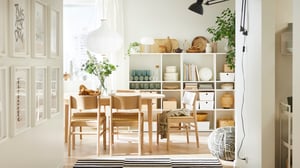
When planning the placement of the furniture, allow a minimum of 80cm space between a wall and desk or between a self and the desk. This gives enough space to manoeuvre a chair in and out freely and for reaching storage comfortably.

Windows in front or behind the computer create reflections on the screen. The daylight should preferably come from the side.
   
  The work surface
To prevent tiredness and back pains, it is important to create an ergonomic workspace. The required height and size of the work surface depends on the type of work being done and the equipment used. It is practical to have a desk that is height adjustable to complement the user and the settings of the swivel chair.

When seated, adults are usually most comfortable with a tabletop that is 65 – 80cm high depending on the height of the user. When sitting with the back straight and with relaxed shoulders, the height of the desk should be level with the elbows.

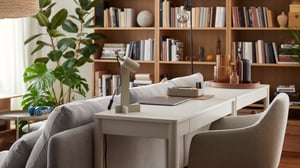
Allow enough space for a lamp, work supplies or other material needed when working. When using a computer, the width of the desk should be at least 80cm to allow enough space for the computer as well as for hand and wrist support.
   
  Work Seating
For hours of work the chair needs to be comfortable. Using an adjustable chair makes it possible to vary the seat position, easing muscle tension following lengthy periods behind a desk or in front of a computer. In general, the longer you sit, the more important it is that your chair can adjust in as many ways as possible.

A rug under a desk or workstation adds atmosphere and balances the acoustics in a work environment. An office chair needs to move back and forth freely without getting caught on the rug. Choose a short pile or tightly woven rug, along with chair castors designed for use with rugs. A plastic floor protector can also be used to protect the rug.
   
  Work Storage
The type of work will determine the storage need. Many workstations today need to accommodate a computer, printer, paper, books and a filling system. The less space there is, the more flexible the storage needs to be. When storage is properly located within a well-organised workspace, tasks can be performed quickly, with few obstructions and little strain.

Things to be stored can be ranked along the lines of: used often, not used often and so on. Things used often should be within arm’s reach from the user, approximately 20 – 30cm, so a person does not have to stretch or work too close to the body.

Open storage gives a good overview but if it is not tidy, it might disturb the work. Organise shelves and other open storage with magazine files and filing system to keep it tidy.

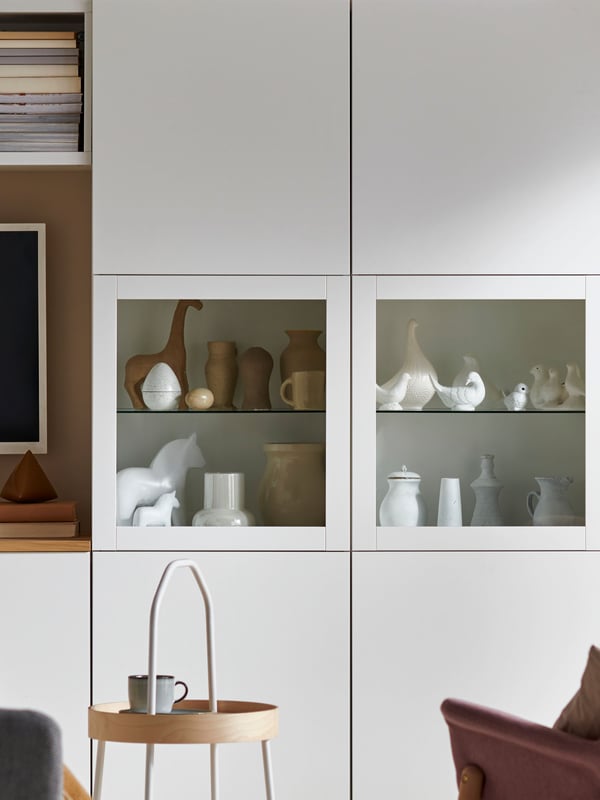
Wall mounted cabinets or shelves as well as desktop storage make use of the often wasted space directly above the desk. Use them to keep books, CDs, binders and files easily accessible.
   
  Work Lighting
Good lighting is vital for any workspace. Weak or poorly directed lighting can result in eye, neck and back strain. Often the solution is as easy as changing to a stronger bulb or moving the light or choosing a different or more flexible type of light.

Good working light includes a combination of daylight, general light and functional light that does not produce glare or reflections on the work surface and mood lighting to reduce sharp contrasts. Having the right mix of lighting is often the only way to make a home office functional and welcoming and work is less tiring.

General lighting can come from a ceiling lamp. For functional lighting at a desk, choose a work lamp that is adjustable sideways as well as up and down, and that can direct the light exactly when needed. Mood lighting helps to soften harsh contrasts from the computer screen and work lamps. Have small lamps behind the computer, lighting under shelving, bookcase lighting or a ceiling lamp with a dimmer switch.
   
  Courtesy of IKANO Pte Ltd, © Inter IKEA Systems B.V. 2009


Starting a business in Singapore? Here are a few resources to help you along. 
» Association of Small & Medium Enterprises
» Action Community for Entrepreneurship
» ACRA Biz-file
» Enterprise One 
» Economic Development Board 
» International Enterprise Singapore 
» SG Entrepreneurs 
» Singapore-Business.com 
» Singapore Business Federation 
» Singapore Business and Professional Women's Association 
» Singapore International Chamber of Commerce 
» Singapore SME Portal  
» SPRING Singapore  
» SME Toolkit Singapore 
» URA Home Office Scheme  
» Women Enterprise Workz